

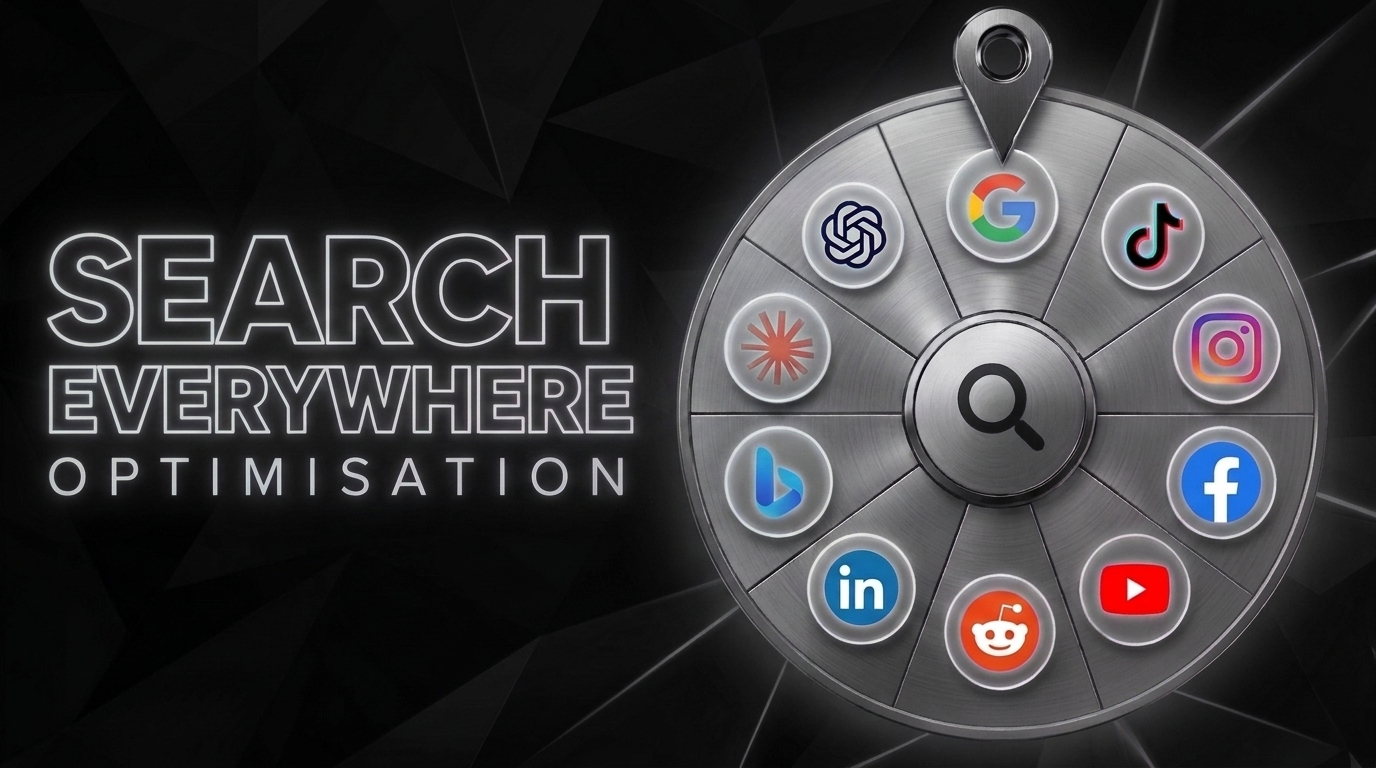
Search Everywhere Optimization is the new standard, as traditional SEO quietly loses its grip. For the last two decades, the playbook for growing a business online was straightforward: build a site, target keywords, write blog posts, and wait for Google to send traffic.
That playbook doesn’t work anymore. Nobody searches in just one place.
1. The Death of the Single Search Bar
Think about how you actually look for answers today. Traditional search behavior has completely fragmented. A massive chunk of your audience never touches a standard Google search result when deciding what to buy:
- Looking for a software tool or B2B solution? You check Reddit or ask ChatGPT.
- Looking for a product review or tutorial? You search YouTube.
- Looking for recommendations or visual proof? You search TikTok, Pinterest, or LinkedIn.
Both modern Google algorithms and large language models (LLMs) like ChatGPT, Claude, and Perplexity don’t just scrape your domain anymore. They map your entire digital footprint across the web to evaluate your authority.
| LEGACY SEO VS. SEARCH EVERYWHERE OPTIMIZATION (GEO) | ||
|---|---|---|
| Strategy | Legacy SEO Playbook | Search Everywhere Reality |
| Primary Target | Google’s 10 blue links | AI Engines, Visual Search (Pinterest/YouTube), Social Feeds |
| Content Format | Keyword-stuffed 2,000-word articles | Atomic answers, structured data, and native video |
| Authority Signal | Quantity of backlinks | Brand mentions, semantic consensus, and digital PR |
| User Journey | Search ➔ Click ➔ Read Website | Zero-click discovery ➔ AI synthesis ➔ Direct Conversion |
2. The 3 Pillars to Own Your Search Everywhere Footprint
When an AI engine synthesizes an answer or recommends a B2B solution, it pulls consensus signals. If you only optimize a website and ignore everywhere else, you look like a ghost to AI crawlers. Here is exactly how to execute across the three fronts of modern search:
Pillar 1: Own Your Technical Core (Root Domain Authority)
Stop relying on marketing fluff. AI models need factual precision and machine-readable formatting.
- Optimize for Atomic Answers: LLMs thrive on direct synthesis. State the exact, literal answer to a user’s problem in the first 1-2 sentences of a section before expanding on the details.
- Structure with Schema: Implement JSON-LD markup (like FAQPage and Article schema) to explicitly tag your data, making it effortless for crawlers to parse without hallucinating.
- Build a Knowledge Hub: Transition from sales-heavy landing pages to clean, structured documentation hubs that serve as canonical truth for your industry.
Pillar 2: Distribute Native Answers (Zero-Click Content)
You cannot force buyers off their favorite platforms. You have to intercept them where they already scroll.
- Visual Search Integration: Treat YouTube and Pinterest as massive search engines. Use text-overlay graphics (which computer vision easily reads) and optimize video metadata for technical queries.
- In-Feed Authority: Repurpose your root domain insights into native, zero-click threads on X and LinkedIn. AI engines scan these social signals to gauge industry consensus and brand relevance.
Pillar 3: Build Verifiable PR (Consensus Signals)
If ChatGPT is going to recommend your software, it needs proof that other people trust you too.
- Industry Mentions: Secure non-linked brand mentions in high-authority third-party publications. AI engines track entities, not just hyperlinks.
- Podcast and Video Interviews: The transcripts from industry podcasts are ingested by AI crawlers. Speaking on authoritative shows feeds directly into your brand’s semantic footprint.
Stop optimizing for a single search engine. Show up everywhere your buyers are looking.

3. Frequently Asked Questions (FAQs)
What is Search Everywhere Optimization?
It is the strategic framework of optimizing a brand’s digital presence across all modern discovery platforms—including AI engines, visual search networks, and social feeds—rather than solely focusing on legacy Google text search.
Why is traditional SEO dropping in effectiveness for B2B?
User search behavior has fragmented. Buyers now rely heavily on YouTube, ChatGPT, and social consensus for discovery. Brands that rely solely on website text optimization are invisible to a massive percentage of high-intent buyers.
How do LLMs evaluate a brand for citations?
AI models scan the web for consensus signals. They cross-reference the structured, atomic documentation on your root domain with verifiable mentions in digital PR, third-party media, and active social platform discussions to ensure data reliability.
Source: Fastgrowing.ai Organic Growth for the AI Search Era.
This article is part of the Fastgrowing.ai GEO Resource Hub.
Ready to Dominate the Entire Search Ecosystem?
Stop wasting your marketing budget on legacy SEO agencies that cannot rank you inside AI search engines or visual platforms.
Get Free AI Search LeadGen Roadmap built specially for your industry – Local, B2B, SAAS or Ecommerce
About the author: This guide was created by Fastgrowing.ai, an organic growth agency that helps local and global businesses thrive in the AI Search Reality. Book a consultation here.